



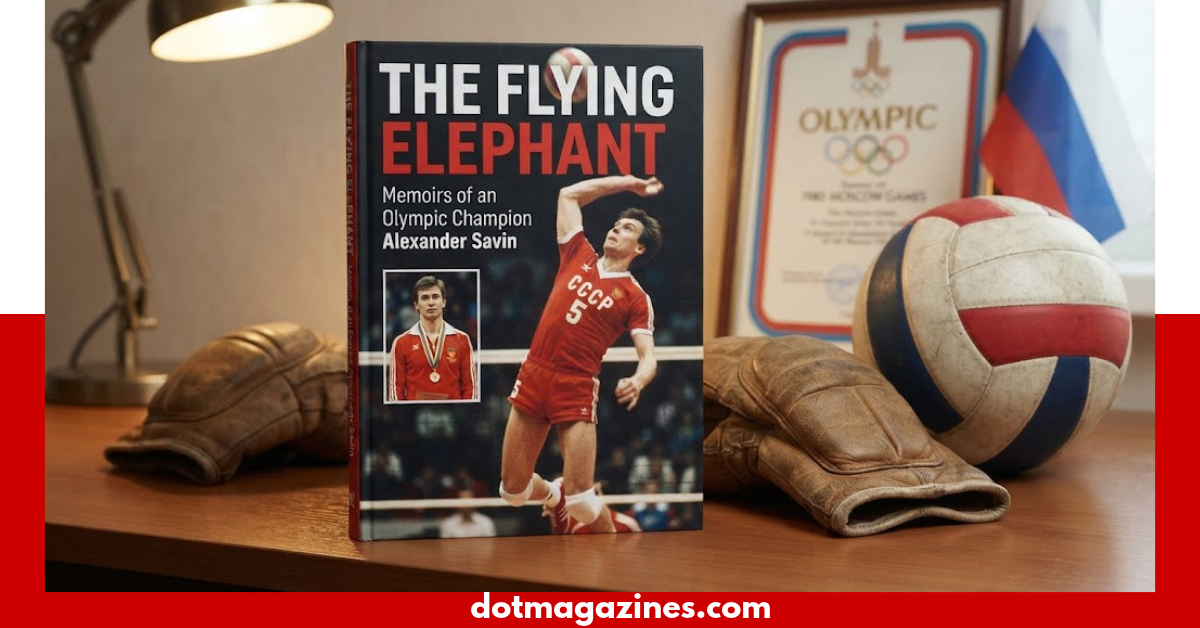
The flying elephant memoirs of an olympic champion alexander savin introduces readers to the sporting life of Aleksandr Borisovich Savin, a Soviet volleyball player who competed at the 1976 Montreal and 1980 Moscow Olympic Games.
Savin won Olympic silver in 1976 and Olympic gold in 1980. Olympedia records him as a two-time Olympic medalist, while the International Volleyball Hall of Fame recognizes him as an Olympic gold medalist and inducted him in 2010.
The English edition of The Flying Elephant emerged from a family-led translation project. Andrei Savine, Savin’s half-brother, described the work as a project that eventually became an effort to preserve the memories of teammates, coaches, friends, and an important period in volleyball history.
Quick Answer
The Flying Elephant: Memoirs of an Olympic Champion is a memoir associated with Alexander Savin’s career in elite Soviet volleyball. It connects his personal sporting journey with Olympic competition, teammates, coaching, and the history surrounding one of the Soviet Union’s strongest volleyball generations.
Who Was Alexander Savin?
Alexander Savin, officially listed by Olympedia as Aleksandr Borisovich Savin, was born on July 1, 1957, in Taganrog. Olympedia records his height at 200 cm and his affiliation with CSKA Moskva.
Savin competed for the Soviet Union in men’s volleyball. His Olympic career included two Games and two medals: silver at Montreal in 1976 and gold at Moscow in 1980.
His career also extended well beyond the Olympics. The International Volleyball Hall of Fame records major international successes with the Soviet team, including European Championship titles and victories at the 1977 FIVB World Cup and 1978 FIVB World Championship.
That background gives the memoir an important historical setting. Savin was not simply an athlete who appeared at one Olympic Games; he competed during a highly successful period for Soviet men’s volleyball.
Alexander Savin’s Olympic Journey
The story behind the flying elephant memoirs of an olympic champion alexander savin becomes clearer when his two Olympic appearances are viewed together.
At the 1976 Montreal Games, Savin and the Soviet team reached the men’s volleyball final. The Soviet Union lost a close five-set final to Poland and received the silver medal. The International Volleyball Hall of Fame notes that Savin played all five matches during the tournament.
Four years later, the setting changed dramatically. Moscow hosted the 1980 Olympics, and the Soviet men’s team entered the tournament with the chance to win gold on home soil.
Savin again played every match. The Soviet Union defeated Bulgaria 3–1 in the final, giving Savin his Olympic gold medal.
Alexander Savin Olympic Record
| Olympic Games | Host City | Country Represented | Result | Medal |
| 1976 | Montreal | Soviet Union | 2nd place | Silver |
| 1980 | Moscow | Soviet Union | 1st place | Gold |
Olympedia confirms both Olympic results and lists Savin with one gold and one silver medal.
This progression from Olympic silver to Olympic gold provides an important framework for understanding Savin’s sporting story.
What Does The Flying Elephant Memoir Cover?
The flying elephant memoirs of an olympic champion alexander savin is best understood through Savin’s sporting career and the people connected to it.
The available first-hand information about the English edition shows that the translation was more than a simple language conversion. Andrei Savine explained that working through the Russian manuscript meant understanding expressions, people, relationships, and memories connected with Savin’s life.
The result brings together several layers of sports history:
- Olympic volleyball
- Soviet-era international competition
- Team relationships
- Coaches and teammates
- Athletic preparation
- Personal memories
- Volleyball culture
- Historical photographs
- The transition of memories from Russian into English
Rather than treating an Olympic medal as the entire story, the memoir gives readers an opportunity to explore the people and experiences surrounding Savin’s career.
Why Is The Title The Flying Elephant?
The title The Flying Elephant immediately creates an interesting image.
In volleyball, physical size can provide an advantage at the net, but elite competition also demands movement, timing, coordination, and jumping ability. Savin stood 200 cm tall, according to Olympedia.
The title therefore creates a memorable contrast between physical presence and movement. However, readers should distinguish interpretation from documented fact: the primary sources reviewed for this article do not provide a definitive explanation from Savin himself for every aspect of the title.
That distinction matters when discussing a memoir. A good book guide should separate what the author or official records establish from what readers might infer.
The 1976 Montreal Olympics: Silver Before Gold
The 1976 Olympics form an important chapter in Savin’s career.
The Soviet men’s volleyball team entered Montreal with significant expectations. According to the International Volleyball Hall of Fame, the team moved through pool play successfully and defeated Cuba in the semifinal.
The final against Poland ended differently. Poland won 3–2, leaving the Soviet team with silver. Savin played in all five matches.
That result became part of the larger road toward Moscow.
Four years later, Savin returned to Olympic competition with the Soviet team and finished with the medal that had eluded him in Montreal.
The 1980 Moscow Olympics: Olympic Gold
The 1980 Moscow Olympics represent the defining Olympic achievement in the flying elephant memoirs of an olympic champion alexander savin.
The Soviet team opened its campaign with a 3–1 victory over Czechoslovakia. It then defeated Italy, Bulgaria, and Cuba in pool play before progressing through the knockout stage.
The semifinal against Romania ended with another Soviet victory. In the final, the Soviet Union defeated Bulgaria 3–1 and claimed Olympic gold.
Savin played in all six matches, according to the International Volleyball Hall of Fame.
The Key Olympic Turning Point
The difference between 1976 and 1980 gives the story a clear sporting arc:
1976: Olympic silver
↓
Four years of international competition
↓
1980: Olympic gold
This is one reason Savin’s career provides useful context for readers interested in athletic development and competitive persistence.
Alexander Savin and Soviet Volleyball
Savin competed during an important era for Soviet volleyball.
The International Volleyball Hall of Fame records Soviet victories at the 1977 FIVB World Cup and 1978 FIVB World Championship before the 1980 Olympic victory. It also records European Championship titles in 1977 and 1979 during this period.
Olympedia’s record extends the international picture further, listing Savin among medalists at the European Volleyball Championships and World Volleyball Championships.
For readers studying volleyball history, this context matters. Savin’s Olympic gold did not stand alone; it came during a broader period of sustained success for the Soviet men’s national team.
What Makes This Olympic Memoir Historically Interesting?
The historical value of the flying elephant memoirs of an olympic champion alexander savin comes partly from its connection to a specific generation of athletes.
The book concerns a period when Soviet volleyball held a major place in international competition. Savin’s career crossed several major tournaments, including the Olympics, World Championships, World Cup, and European Championships.
The English translation also adds another layer of historical preservation.
Andrei Savine described translating the memoir as a family project that helped him discover the people and stories surrounding Alexander Savin’s career. He specifically described the English book as his contribution to preserving that history.
For international readers, that makes the book more than an account of volleyball results. It also serves as a bridge between a Russian-language sporting past and an English-speaking audience.
How Was The English Edition Created?
One of the most interesting details comes directly from Andrei Savine.
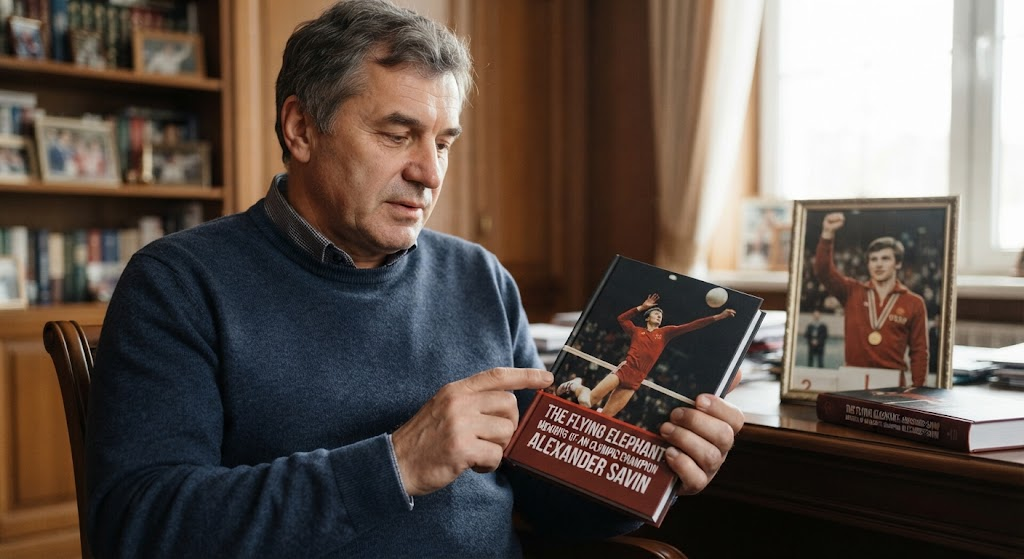
In his account of the project, he explains that he spent more than a year working on the English translation of Savin’s memoir. Alfredo Cabero and Ioulia Soudakova were involved in the work, and Andrei described the process as a personal reconnection with his half-brother and with the people named in the memoir.
He also explained that the translation required more than replacing Russian words with English equivalents. Russian expressions and cultural references sometimes required interpretation so the meaning could remain understandable in English.
This makes the English edition especially relevant to readers who want access to Savin’s story without reading Russian.
The Flying Elephant Book Details
The English edition is listed on Amazon under the title The Flying Elephant: Memoirs of an Olympic Champion. Amazon’s listing identifies the Kindle edition with publication date October 26, 2025 and the identifier B0FXVDWW16.
Andrei Savine’s first-hand post also confirms that the English edition was made available in Kindle format on Amazon.
| Book Detail | Information |
| Title | The Flying Elephant: Memoirs of an Olympic Champion |
| Author | Alexander Savin |
| Format discussed here | Kindle edition |
| Language | English edition |
| Publication date listed by Amazon | October 26, 2025 |
| Amazon identifier | B0FXVDWW16 |
| Main subject | Olympic volleyball and Savin’s sporting life |
| Sport | Volleyball |
| Olympic Games covered by career context | 1976 Montreal and 1980 Moscow |
| Olympic medals | Silver and gold |
| Historical setting | Soviet-era international volleyball |
The publication information above is based on the available Amazon listing and first-hand account from the translation project rather than third-party review websites.
Does The Book Focus Only on Olympic Medals?
No. The broader value of the flying elephant memoirs of an olympic champion alexander savin comes from placing the Olympic achievements inside Savin’s larger sporting life.
His career involved years of international volleyball, club competition, national-team responsibilities, coaches, teammates, and major tournaments.
The Olympic results provide the most recognizable milestones, but the surrounding career gives those results meaning.
For example, the 1976 silver medal becomes more significant when viewed alongside the 1980 gold medal. The two results show different points in the same athlete’s Olympic journey rather than two isolated statistics.
Alexander Savin’s Volleyball Legacy
Savin’s legacy has already received formal recognition.
The International Volleyball Hall of Fame inducted him in 2010 as a male indoor player. Its biography identifies him as an Olympic gold medalist and highlights his role in the Soviet team’s return to Olympic victory in 1980.
Olympedia independently records his Olympic medal history and international competition record.
These records provide useful trust signals for readers researching Alexander Savin because they come from established sports-history organizations rather than anonymous biographies.
Key Legacy Points
- Olympic silver medalist in 1976
- Olympic gold medalist in 1980
- Soviet national-team player
- Member of the International Volleyball Hall of Fame
- 2010 Hall of Fame inductee
- Competitor during a major era of Soviet volleyball
- Connected to multiple European and world championship successes
Why Volleyball Fans May Find The Memoir Valuable
For volleyball fans, the flying elephant memoirs of an olympic champion alexander savin offers historical context around a player who competed at the highest international level.
The book also provides an opportunity to look beyond modern volleyball. Today’s game has different tactics, training systems, equipment, media coverage, and professional structures.
A memoir from a Soviet-era Olympic champion can therefore help readers understand how elite volleyball looked and felt during an earlier period.
It can also encourage younger players to study the history of their sport instead of viewing volleyball only through current competitions.
What Can Athletes Learn From Alexander Savin’s Career?
Savin’s documented career offers several practical themes for athletes.
1. Long-term development matters
Savin’s Olympic career stretched across two Games. The four-year gap between Montreal and Moscow shows how an athlete’s story can continue after a major disappointment.
2. Team performance matters
Volleyball is a team sport. Savin’s Olympic medals came as part of the Soviet national team, making teamwork central to the story.
3. International experience builds perspective
Savin competed at multiple major tournaments. That exposure created a career that extended beyond a single Olympic cycle.
4. Records preserve sporting history
The memoir project also demonstrates how personal memories can complement official statistics. A medal table tells readers who won; a memoir can preserve the human stories surrounding those results.
The Flying Elephant and Volleyball History
The importance of the flying elephant memoirs of an olympic champion alexander savin extends beyond one athlete.
Soviet volleyball produced teams that dominated major international competitions during several periods. Savin’s career sits within one of those generations.
Official sports records establish his Olympic medals and major competition history, while the translation project provides a personal perspective on preserving memories from that era.
That combination makes the book relevant to several audiences:
- Volleyball historians
- Olympic sports fans
- Athletes
- Coaches
- Sports researchers
- Readers interested in Soviet sports history
- Fans of athlete memoirs
- Readers studying international volleyball
Is The Flying Elephant Available in English?
Yes. The English edition is available in Kindle format.
Andrei Savine specifically states that the memoir was translated into English and made available through Amazon Kindle. Amazon’s listing identifies the English Kindle edition as The Flying Elephant: Memoirs of an Olympic Champion.
This is important because Savin’s original sporting life belongs largely to a Russian and Soviet historical context. The English edition allows a wider international readership to access the memoir.
What Should Readers Know Before Reading It?
Readers should approach the flying elephant memoirs of an olympic champion alexander savin as a sports memoir connected to a particular historical period.
It is not simply a modern motivational book about winning.
Savin’s career developed inside Soviet-era international sport, and understanding that setting can make the story more meaningful. His Olympic record, international achievements, and Hall of Fame recognition provide the factual framework around the personal narrative.
Readers should also distinguish documented information from interpretations made by later websites. For reliable research, official sports records and the book’s own publication information should take priority over unsupported claims found in secondary articles.
Who Should Read The Flying Elephant?
The flying elephant memoirs of an olympic champion alexander savin can appeal to readers with several different interests.
Volleyball Players
Players can explore the career of an athlete who competed at Olympic and world level.
Coaches
Coaches interested in volleyball history can use Savin’s career as a window into an earlier generation of elite competition.
Olympic Fans
Readers interested in Olympic history can follow Savin’s progression from silver in Montreal to gold in Moscow.
Sports Historians
The memoir has particular relevance for people studying Soviet volleyball and international sport during the late twentieth century.
General Readers
You do not need to be a technical volleyball expert to understand the central themes of competition, teamwork, disappointment, achievement, and historical memory.
Frequently Asked Questions
1. Who wrote The Flying Elephant: Memoirs of an Olympic Champion?
Alexander Savin is the athlete and memoirist associated with The Flying Elephant. The English edition was produced through a translation project involving his family and collaborators. Andrei Savine describes his role in translating the memoir into English.
2. What sport did Alexander Savin play?
Alexander Savin played volleyball for the Soviet Union. Olympedia identifies him as a Soviet Olympic volleyball competitor and records his participation at the 1976 and 1980 Olympic Games.
3. Did Alexander Savin win an Olympic gold medal?
Yes. Savin won Olympic silver in men’s volleyball at Montreal 1976 and Olympic gold at Moscow 1980.
4. When was the English Kindle edition published?
Amazon lists October 26, 2025, as the publication date for the Kindle edition of The Flying Elephant: Memoirs of an Olympic Champion.
5. Is Alexander Savin in the International Volleyball Hall of Fame?
Yes. The International Volleyball Hall of Fame lists Savin as a 2010 inductee in the male indoor player category.
6. Why is Savin’s memoir important for volleyball history?
It connects a first-person memoir with a documented period of major Soviet volleyball success. Savin’s career included Olympic medals, World Championship and World Cup success, and multiple European Championship victories.
Conclusion
The flying elephant memoirs of an olympic champion alexander savin offers readers a route into the career of one of the Soviet era’s notable volleyball players.
Savin’s Olympic record is clear: silver in Montreal in 1976 and gold in Moscow in 1980. His broader international career and 2010 induction into the International Volleyball Hall of Fame add important context to those achievements.
The English translation adds another dimension. Andrei Savine’s account shows that bringing the memoir to English became a family project focused not only on Alexander Savin but also on preserving the memories of teammates, coaches, friends, and a significant chapter of volleyball history.
For volleyball fans, Olympic-history readers, athletes, coaches, and sports researchers, The Flying Elephant provides an opportunity to look beyond medal tables and explore the personal story connected to them.