




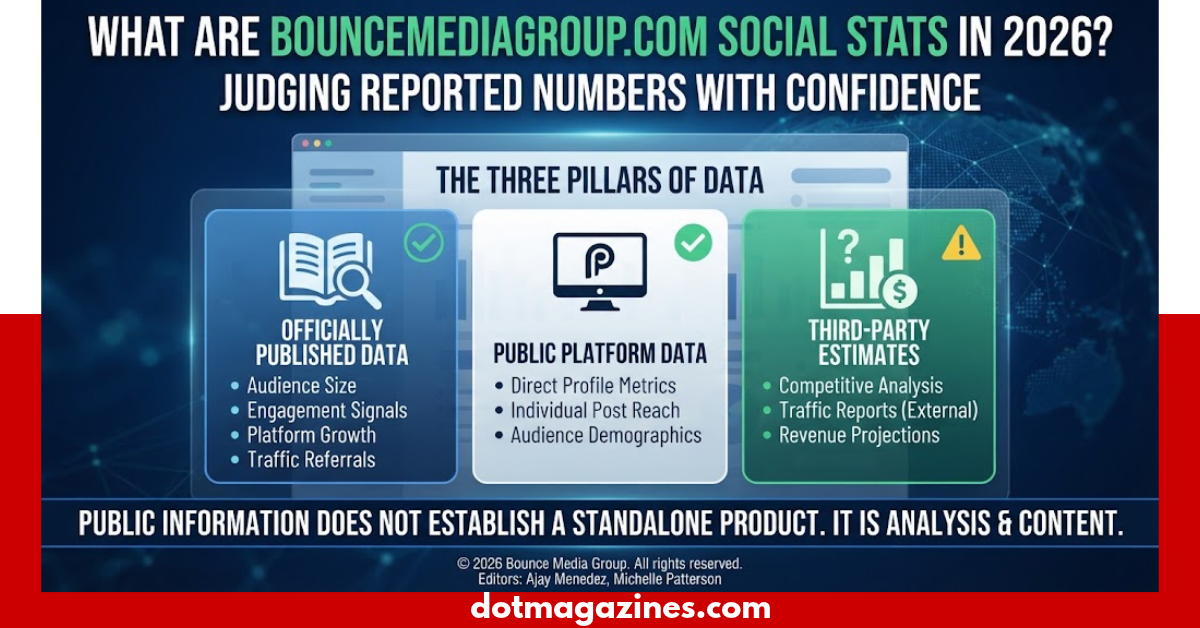
Bouncemediagroup.com social stats refers to social media performance information connected with Bounce Media Group, including audience size, engagement, reach, impressions, clicks, referrals, and growth.
The important point is that there is no single publicly verified follower total that can safely represent the brand across every platform. Bounce Media Group publishes material about social statistics on its own website, but different online reports give different numbers. Therefore, readers should separate officially published information, public platform data, and third-party estimates before using any figure for business decisions.
What Is Bouncemediagroup.com?
Bounce Media Group presents itself as a publication covering media, marketing, technology, industry news, social statistics, and technology trends. Its official About Us page identifies Ajay Menedez and Michelle Patterson as editors and describes their respective editorial and social-media expertise.
The website also has a dedicated Social Stats category. Its archive shows that the site has published social-media-related material covering platforms, trends, and online behavior for several years.
This matters because the phrase Bouncemediagroup.com social stats can easily sound like the name of a software dashboard. Public information does not establish that it is a standalone analytics product. It is better understood as a search phrase connected with Bounce Media Group’s social-media information and analysis.
What Does Bouncemediagroup.com Social Stats Mean?
In simple terms, Bouncemediagroup.com social stats means the collection of measurable signals used to understand social-media performance associated with Bounce Media Group.
These signals can include:
- Followers
- Follower growth
- Post reach
- Impressions
- Likes
- Comments
- Shares
- Reposts
- Video views
- Link clicks
- Engagement rate
- Referral traffic
- Conversion activity
- Audience demographics
Each metric answers a different question. A follower count tells you about potential audience size, while engagement shows how actively people respond to content.
Reach and impressions also should not be treated as the same thing. Reach generally concerns unique people exposed to content, while impressions count displays or exposures.
Bouncemediagroup.com Social Stats: What Can Be Verified?
This is where careful research becomes important.
Several 2026 articles publish precise figures for Bounce Media Group, but the numbers are not consistent. One report claims a combined audience approaching 240,000, while another cites more than 150,000 followers. Other pages provide percentages for traffic, engagement, or platform distribution without linking to individual public accounts or a live analytics dashboard.
That means these figures should be treated as reported estimates rather than definitive current statistics unless the underlying account or analytics source can be checked.
The official Bounce Media Group website itself discusses social metrics such as followers, engagement, traffic, and conversions.
Verification Table
| Metric | What it tells you | Publicly verifiable? | How to interpret it |
| Follower count | Potential audience size | Not consistently verified | Check the individual social profile |
| Follower growth | Audience expansion | Limited publicly | Compare dated snapshots |
| Reach | Unique exposure | Usually account-level | Requires platform analytics |
| Impressions | Total content displays | Partly public | Do not confuse with reach |
| Likes | Basic interaction | Often visible | Useful but limited alone |
| Comments | Conversation | Often visible | Stronger context signal |
| Shares/Reposts | Content spread | Often visible | Valuable for resonance |
| Engagement rate | Interaction relative to audience/reach | Usually account-level | Check calculation method |
| Social referrals | Website visits from social | Requires website analytics | Use GA4 or equivalent |
| Conversions | Actions after social visits | Usually private | Needs analytics access |
| Audience demographics | Age, location, interests | Mostly private | Platform analytics required |
Are the Reported Follower Numbers Reliable?
The safest answer is not automatically.
A large number can look authoritative simply because it is precise. But precision does not prove accuracy. If two published reports give substantially different totals and neither provides a directly verifiable account list or analytics dashboard, the numbers should not be combined or repeated as established facts.
This is one of the most important lessons when researching Bouncemediagroup.com social stats.
Social accounts also change continuously. Followers can increase, decrease, or move between platforms, while deleted posts and inactive accounts can change the visible picture.
For that reason, a good report should always include:
- The platform being measured.
- The exact account or profile.
- The date checked.
- The metric definition.
- Whether the figure is public or private.
- The original source of the number.
Without those details, a statistic is better described as an estimate.
Which Social Platforms Matter Most?
Bounce Media Group’s own published material discusses several major social networks, including Instagram, Facebook, X, LinkedIn, and TikTok.
However, platform presence should not automatically be interpreted as proof of a particular follower count or engagement rate.
Each network measures performance differently.
| Platform | Useful public signals | Stronger private metrics |
| Followers, likes, comments, views | Reach, saves, shares, audience data | |
| Followers, reactions, comments, shares | Detailed reach and audience insights | |
| X | Followers, reposts, replies, likes | Detailed post and campaign analytics |
| Followers, reactions, comments, reposts | Page visitors, demographics, deeper analytics | |
| TikTok | Followers, likes, views | Watch time, retention, audience insights |
X’s official analytics documentation, for example, identifies impressions, link clicks, replies, reposts, and profile clicks as measurable post activity signals.
LinkedIn likewise provides Page analytics covering reach, engagement, followers, visitors, page views, and audience information for administrators.
How to Read Bouncemediagroup.com Social Stats Correctly
The best way to read Bouncemediagroup.com social stats is to look at several metrics together.
Imagine a page has 50,000 followers but receives only a handful of meaningful interactions on most posts. Its follower number looks impressive, but the audience may not be highly active.
Now imagine another account has 10,000 followers and regularly receives strong comments, shares, clicks, and returning visitors. That smaller account may have greater practical value.
A Better Evaluation Formula
Think about social performance through five areas:
Audience → Reach → Engagement → Traffic → Conversion
This creates a clearer picture than followers alone.
For example:
- Audience: How many people follow the account?
- Reach: How many unique users see the content?
- Engagement: How many people interact?
- Traffic: How many visit the website?
- Conversion: How many complete a valuable action?
The final two steps are particularly important for businesses.
Why Engagement Matters More Than Follower Count
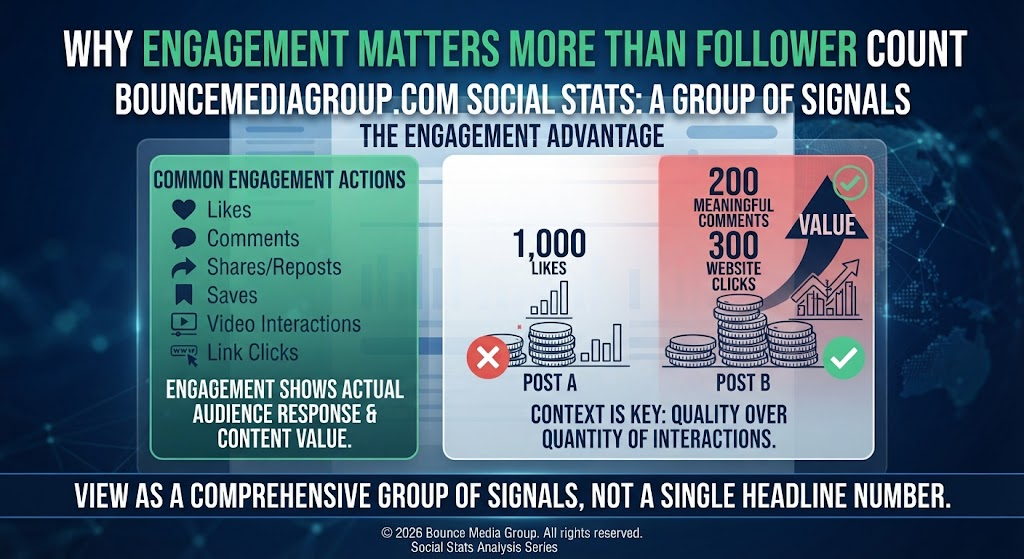
Engagement shows whether people actually respond to content.
Common engagement actions include:
- Likes
- Comments
- Shares
- Reposts
- Saves
- Video interactions
- Link clicks
But even engagement needs context.
A post with 1,000 likes may look successful, yet 200 meaningful comments and 300 website clicks could make another post much more valuable for a publisher or business.
Therefore, Bouncemediagroup.com social stats should be viewed as a group of signals rather than one headline number.
How Social Traffic Can Be Measured
Website traffic gives social statistics another layer of meaning.
Google Analytics uses traffic-source dimensions to identify where visitors originate and how they interact with a website. Sources can include search engines, social platforms, referrals, email, and direct traffic.
For campaigns, UTM parameters can make tracking more precise.
A campaign link can include:
- utm_source
- utm_medium
- utm_campaign
- utm_content
Google recommends using consistent campaign tagging so marketers can identify which sources and campaigns generate visits.
This is especially useful when a brand publishes similar content across several platforms.
What Are UTM Parameters?
UTM parameters are small tracking labels added to URLs.
For example, a publisher could create separate campaign links for Instagram, LinkedIn, and X. Analytics can then distinguish the traffic generated by each source.
This makes Bouncemediagroup.com social stats more useful because social activity can be connected to actual website visits rather than judged only through likes or follower numbers.
A basic structure looks like this:
| Parameter | Purpose |
| utm_source | Identifies the traffic source |
| utm_medium | Identifies the marketing channel |
| utm_campaign | Identifies the campaign |
| utm_content | Differentiates creatives or links |
| utm_term | Identifies a keyword when relevant |
Google Analytics explains that traffic-source dimensions form the foundation for understanding acquisition and attribution.
What Do Bounce Media Group’s Published Reports Say?
Bounce Media Group has published several pages discussing its social performance.
One 2026 report describes social referrals, platform traffic, engagement, mobile traffic, and audience behavior. It reports a 14% year-over-year increase in social referrals and gives platform percentages for Facebook, Instagram, X, and LinkedIn.
Another published report describes an 18% year-over-year follower increase and a combined audience near 240,000. It also discusses video engagement and platform-specific performance.
These figures are useful as published claims, but they should not automatically be treated as independently verified measurements.
That distinction improves the trustworthiness of any discussion about Bouncemediagroup.com social stats.
Why Different Social Stats Appear Online
There are several normal reasons why social figures can differ.
1. Different Measurement Dates
A follower count from January may be different from one checked in September.
2. Different Platforms Included
One report may include Instagram, Facebook, X, and LinkedIn while another adds TikTok or another channel.
3. Different Definitions
One source may count followers while another counts total audience, impressions, or monthly users.
4. Estimated Data
Some websites use third-party estimates rather than direct platform analytics.
5. Private Analytics
Important numbers such as conversion rate, audience retention, and exact referral revenue usually require account or website analytics access.
This explains why a single definitive number should not be presented without a clear source.
Bouncemediagroup.com Social Stats vs. Social Media Analytics
It helps to distinguish a social statistics report from an actual analytics dashboard.
A real analytics dashboard normally provides account-specific information such as:
- Historical performance
- Audience growth
- Post-level results
- Reach
- Impressions
- Clicks
- Demographics
- Conversion tracking
- Date filters
Public articles can summarize these concepts, but they cannot automatically expose private account analytics.
Therefore, readers searching for Bouncemediagroup.com social stats should first determine whether they want an explanation of social performance or access to private account data.
What Metrics Should Marketers Track?
If the goal is to evaluate social performance, use a balanced scorecard.
| Goal | Main metric | Supporting metric |
| Grow audience | Follower growth | New followers |
| Increase visibility | Reach | Impressions |
| Improve interaction | Engagement rate | Comments and shares |
| Drive visitors | Link clicks | CTR |
| Generate leads | Conversions | Conversion rate |
| Improve content | Post-level engagement | Saves and shares |
| Build loyalty | Returning visitors | Repeat engagement |
| Improve campaigns | Cost per result | ROAS |
This approach turns raw Bouncemediagroup.com social stats into information that can support practical decisions.
What Does Good Social Performance Look Like?
There is no universal number that makes an account successful.
A good result depends on:
- Industry
- Platform
- Audience size
- Content type
- Campaign objective
- Posting frequency
- Organic or paid distribution
- Conversion goal
For example, a news post may aim for rapid shares, while a B2B LinkedIn post may aim for qualified leads.
That is why comparing two accounts only by likes or followers can produce the wrong conclusion.
How to Verify Social Stats Yourself
Anyone researching Bounce Media Group can use a simple verification process.
Step 1: Find the Official Website
Start with the official Bounce Media Group website and its About and Social Stats sections.
Step 2: Identify Official Social Profiles
Do not assume that an account with a similar name belongs to the brand.
Step 3: Record the Date
Write down when the public number was checked.
Step 4: Separate Public and Private Data
Follower counts may be visible, while reach, demographics, and conversions may require administrator access.
Step 5: Compare Several Metrics
Look beyond followers and examine interaction, clicks, and traffic.
Step 6: Check Website Analytics
For website campaigns, use properly tagged links and analytics data.
Step 7: Label Estimates Clearly
If a number comes from a third-party estimate, call it an estimate.
This process creates a much more dependable picture than copying a number from a random article.
What Makes Social Stats Trustworthy?
A trustworthy social-statistics report should answer five questions:
Who collected the data?
When was it collected?
Where did the data come from?
What exactly does the metric measure?
Can another person verify it?
These questions are simple, but they prevent many misleading comparisons.
For Bouncemediagroup.com social stats, the strongest approach is therefore to prioritize official platform data and clearly labeled first-party reporting over unsupported numerical claims.
Strengths and Limitations of the Available Data
Strengths
- Bounce Media Group has a dedicated Social Stats content category.
- Its website discusses multiple social platforms and measurement methods.
- The site provides editorial information about its team.
- Social metrics such as engagement, traffic, and conversion are clearly relevant to its publishing focus.
- Official analytics platforms provide established methods for measuring social performance.
Limitations
- Publicly reported follower totals vary.
- Exact account-level analytics are not openly available through ordinary web pages.
- Some published figures are estimates or claims rather than independently audited results.
- Social numbers change over time.
- Different reports may use different measurement periods.
A strong article should acknowledge these limitations rather than hide them.
What Can Businesses Learn From These Social Stats?
The bigger lesson goes beyond Bounce Media Group.
Businesses should stop treating follower count as the only measure of social success. A better strategy connects content exposure with engagement, website traffic, leads, sales, or another clearly defined business goal.
Google Analytics supports this type of attribution by connecting traffic sources and campaign information to website activity.
That makes social reporting more useful for decision-making.
For example, if Instagram generates fewer visitors but those visitors convert at a higher rate, Instagram may be more valuable than a platform producing a much larger number of low-quality clicks.
Bouncemediagroup.com Social Stats: Key Takeaways
Here are the most important points:
- Bouncemediagroup.com social stats refers broadly to social-media performance data connected with Bounce Media Group.
- The official website focuses on media, marketing, technology, industry news, and social statistics.
- The site discusses platforms including Instagram, Facebook, X, LinkedIn, and TikTok.
- Several 2026 reports publish numerical estimates, but those figures do not consistently agree.
- No single combined follower number should be treated as definitive without checking the underlying profiles.
- Engagement, reach, clicks, traffic, and conversions provide more useful context than follower count alone.
- Google Analytics can track traffic sources and campaigns through UTM parameters.
- X and LinkedIn provide their own platform-level analytics for deeper measurement.
- Public statistics should always include a measurement date.
- Private analytics should not be presented as public facts.
Frequently Asked Questions
What are Bouncemediagroup.com social stats?
Bouncemediagroup.com social stats refers to social-media performance information associated with Bounce Media Group. It can include followers, engagement, reach, impressions, clicks, referrals, and audience growth.
How many followers does Bounce Media Group have?
There is no single publicly verified combined follower number that can safely be presented as the definitive current figure. Different online reports publish different totals, so individual public profiles should be checked before quoting a number.
Is Bouncemediagroup.com Social Stats an analytics tool?
Public information does not clearly establish it as a standalone analytics software product. The phrase is more commonly used to describe social-media statistics and analysis related to Bounce Media Group.
Which platforms are included in Bounce Media Group’s social presence?
Published Bounce Media Group material discusses platforms such as Instagram, Facebook, X, LinkedIn, and TikTok. The exact active-account mix and public follower counts should be verified directly on the relevant profiles.
Which social metric matters more: followers or engagement?
Engagement is often more useful for understanding audience activity, but neither metric should stand alone. Reach, clicks, website traffic, conversions, and audience quality provide stronger context for evaluating performance.
How can I verify Bouncemediagroup.com social stats?
Check the official website, identify the brand’s actual social profiles, record the date of each public figure, and compare several metrics. For website traffic and campaign results, use analytics data and properly configured UTM parameters.
Conclusion:
Bouncemediagroup.com social stats are best understood as a collection of social-performance signals rather than one magic number.
The available information shows that Bounce Media Group actively publishes material about social statistics and digital trends, but publicly reported numerical figures vary. The most reliable approach is to distinguish first-party claims from independently verifiable platform data and never turn an estimate into a confirmed statistic.