


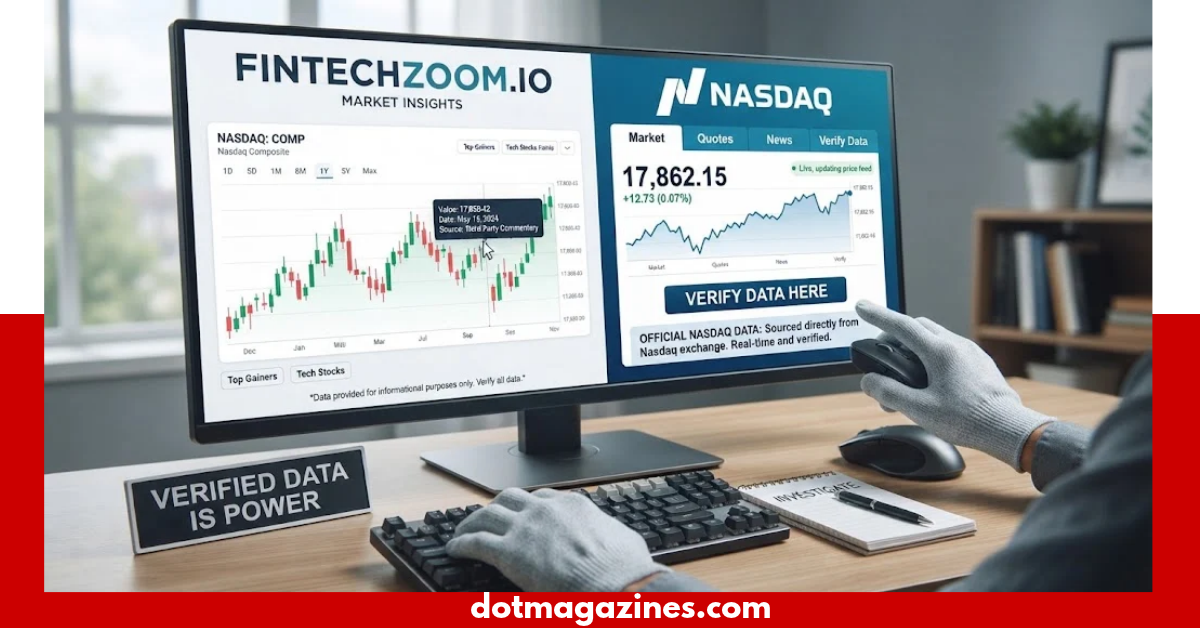
FintechZoom.io describes itself as a financial information platform covering markets such as Nasdaq, Dow Jones, stocks, crypto, gold, silver, and other financial topics. Its Nasdaq page discusses market charts, technical indicators, news, and analysis for readers following technology-heavy markets.
However, an important distinction matters: FintechZoom.io is not Nasdaq itself. Nasdaq operates the Nasdaq Stock Market and publishes its own official index information, methodologies, trading information, and listing requirements. Therefore, readers should treat FintechZoom’s Nasdaq articles as third-party financial coverage and use Nasdaq’s official resources when they need authoritative index or exchange information.
Quick Facts About FintechZoom.io Nasdaq
| Topic | Key Detail |
| Website | FintechZoom.io |
| Main subject | Financial markets and fintech |
| Nasdaq coverage | Market news, charts, analysis and related stock content |
| Official Nasdaq product? | No |
| Official Nasdaq source | Nasdaq.com |
| Important Nasdaq index | Nasdaq Composite |
| Other major index | Nasdaq-100 |
| Market focus | Technology, growth and listed companies |
| Data verification | Compare important figures with primary sources |
| Best use | Research and market education |
| Investment warning | Research tools do not guarantee investment results |
What Is Nasdaq?
To understand fintechzoom.io nasdaq, you first need to understand Nasdaq itself.
Nasdaq is a major U.S. securities market and financial technology company. The Nasdaq Stock Market lists companies across different sectors, with particularly strong representation from technology and growth-oriented businesses.
The Nasdaq Composite Index measures common-type stocks listed on the Nasdaq Stock Market. Nasdaq says the index includes thousands of companies and is market-capitalization weighted, meaning larger companies have a greater influence on its movement.
Major companies associated with the Nasdaq ecosystem include technology and consumer names such as Apple and Microsoft, alongside thousands of other listed companies.
Is FintechZoom.io Nasdaq an Official Nasdaq Service?
No. Fintechzoom.io nasdaq should not be described as an official Nasdaq product.
This distinction is important for both readers and publishers. FintechZoom.io provides its own financial coverage and analysis, while Nasdaq publishes official market information through Nasdaq.com and its index platforms.
For example, Nasdaq’s official Composite page provides index descriptions, methodology information, historical data, performance information, and current index statistics.
Simple Difference
| FintechZoom.io | Nasdaq |
| Independent financial information website | Official exchange and financial-market organization |
| Publishes financial articles | Operates Nasdaq markets |
| Provides market commentary | Publishes official market and index information |
| Covers stocks, crypto and other financial topics | Provides official exchange, index and listing information |
| Useful for research and education | Primary source for Nasdaq market information |
| Not the Nasdaq exchange | Operates the Nasdaq Stock Market |
This distinction strengthens financial content because it prevents readers from confusing independent commentary with official exchange information.
What Does FintechZoom.io Cover About Nasdaq?
The fintechzoom.io nasdaq topic typically centers on market movements, index performance, technology stocks, charts, financial news, and technical analysis.
FintechZoom.io’s published Nasdaq material discusses features such as performance charts, technical indicators, market news, stock quotes, and broader research.
Readers may use this type of content to:
- Follow Nasdaq market trends
- Understand technology-sector movements
- Research individual stocks
- Review historical market performance
- Study technical indicators
- Follow financial news
- Compare market sectors
- Learn basic investment concepts
- Identify questions for deeper research
The strongest approach is to use third-party commentary as a starting point and then verify important numbers, corporate announcements, filings, and index information through primary sources.
How Does the Nasdaq Composite Work?
The Nasdaq Composite is broader than the Nasdaq-100.
Nasdaq states that the Composite measures all Nasdaq-listed domestic and international common-type stocks that meet its methodology. The index is market-capitalization weighted, so companies with larger market values generally have greater influence on the index’s movement.
This makes the Composite useful for studying the overall performance of companies listed on Nasdaq.
Nasdaq Composite vs. Nasdaq-100
| Feature | Nasdaq Composite | Nasdaq-100 |
| Coverage | Broad Nasdaq-listed stock universe | 100 large non-financial Nasdaq-listed companies |
| Purpose | Broad Nasdaq market indicator | Large-company growth/innovation benchmark |
| Company count | Thousands | 100 |
| Weighting | Market-cap weighted | Modified market-cap methodology |
| Common use | Overall Nasdaq market analysis | Large growth and technology exposure |
| Best for | Broad market monitoring | Focused large-company analysis |
A reader searching fintechzoom.io nasdaq may encounter both indexes, so understanding this difference prevents confusion.
What Information Should Investors Check?
Financial websites can make market research faster, but investors should not rely on a single article or chart.
When researching a Nasdaq stock or index, check several categories of information:
1. Current Price
Look at the latest available price and determine whether the information is real-time, delayed, or historical.
2. Trading Volume
Volume shows how actively a security is changing hands. A price move accompanied by unusual volume can deserve closer investigation.
3. Historical Performance
Compare multiple time periods instead of focusing only on a one-day movement.
4. Company Fundamentals
For individual stocks, review revenue, earnings, debt, cash flow, guidance, and regulatory filings.
5. Market Conditions
Interest rates, inflation, economic growth, corporate earnings, and investor sentiment can influence technology-heavy indexes.
6. Official Filings
For U.S.-listed companies, SEC filings provide important primary information about financial performance, risks, ownership, and material events.
How to Read FintechZoom Nasdaq Charts
The chart component of fintechzoom.io nasdaq content can help readers understand price movements visually.
A basic chart-reading process is straightforward:
- Select the appropriate Nasdaq index or stock.
- Choose a suitable time period.
- Identify the overall direction.
- Compare major highs and lows.
- Review trading volume where available.
- Check relevant news around major price movements.
- Compare the information with an official source.
- Avoid treating one indicator as a guaranteed prediction.
Technical indicators can help organize market observations, but they do not remove investment risk.
Common Chart Terms
| Term | Meaning |
| Open | Price at the beginning of a trading session |
| High | Highest price during the selected period |
| Low | Lowest price during the selected period |
| Close | Price at the end of the selected period |
| Volume | Number of shares or units traded |
| Moving Average | Average price over a selected period |
| Support | Price area where buying interest may appear |
| Resistance | Price area where selling pressure may appear |
| Volatility | Degree of price movement |
| Market Trend | General direction of price movement |
What Are Nasdaq Trading Hours?
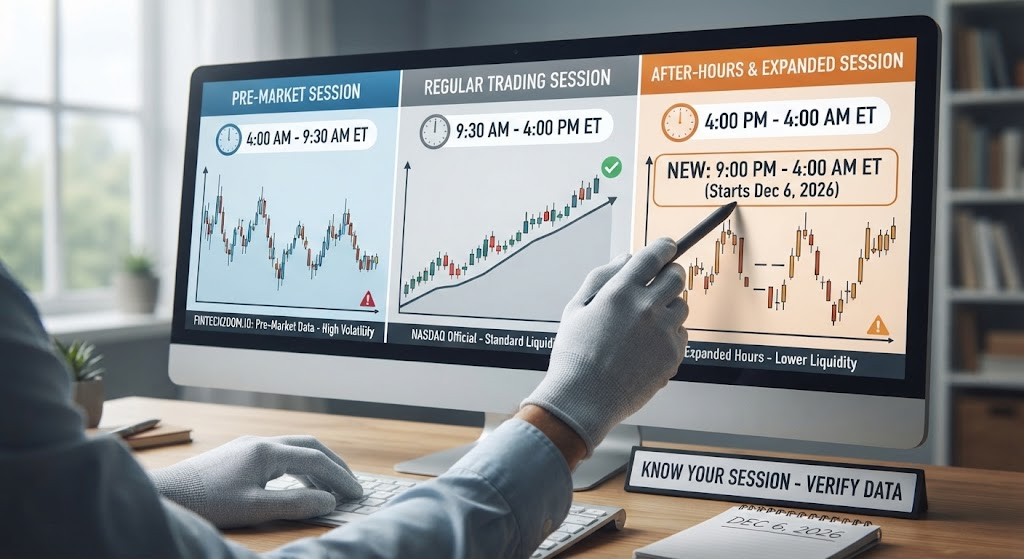
Nasdaq’s regular U.S. stock-market session runs from 9:30 a.m. to 4:00 p.m. Eastern Time, Monday through Friday. Nasdaq also provides pre-market and after-hours sessions, although extended-hours trading can involve greater volatility and lower liquidity.
This matters when reading fintechzoom.io nasdaq market updates because a displayed price may come from regular trading, extended trading, or a previous session.
Nasdaq has also announced plans for expanded trading hours. Its current information says a new 9:00 p.m. to 4:00 a.m. ET session is expected to begin on December 6, 2026, subject to relevant approvals and readiness requirements.
What Are Nasdaq’s Market Tiers?
Nasdaq operates three main market tiers:
- Nasdaq Global Select Market
- Nasdaq Global Market
- Nasdaq Capital Market
Companies must meet applicable financial, liquidity, and corporate-governance requirements to qualify for listing on these markets.
The distinction is useful when researching companies because being listed on Nasdaq does not mean every company has the same size, financial profile, or listing requirements.
Why Do Technology Stocks Matter So Much to Nasdaq?
Technology companies have historically played a major role in Nasdaq’s identity and market activity.
Nasdaq itself describes the Composite as having a particular emphasis on technology-related companies, while also noting that it represents a broad range of companies rather than technology alone.
Large technology and growth companies can therefore have a significant effect on investor sentiment around Nasdaq.
However, investors should avoid assuming that every Nasdaq-listed company is a technology company. The exchange includes businesses from multiple industries.
How Can FintechZoom.io Nasdaq Help New Investors?
For beginners, fintechzoom.io nasdaq searches can be useful for discovering terminology, market topics, stock stories, and explanations.
A beginner can use the information to build a research checklist:
- What index am I looking at?
- What time period does the chart cover?
- Is the price current?
- What caused the recent movement?
- Is there an official company announcement?
- What do the latest financial statements show?
- Is the market move broad or limited to a few large companies?
- What risks could reverse the trend?
This approach turns financial content into a research process rather than a simple buy-or-sell signal.
Can FintechZoom.io Nasdaq Predict Future Prices?
No financial website can guarantee future Nasdaq prices.
The FintechZoom.io Nasdaq article includes long-term projections, but projections should be treated as scenarios rather than guaranteed outcomes.
Markets can change because of earnings, interest rates, inflation, geopolitical events, regulation, economic data, investor sentiment, and unexpected company developments.
A forecast becomes more useful when readers understand its assumptions, time frame, methodology, and uncertainty.
How to Verify FintechZoom.io Nasdaq Data
Before making an investment decision, use a simple verification process.
Step 1: Check Nasdaq
Use Nasdaq’s official index pages for index descriptions, methodology, and market information.
Step 2: Check the Company
If the article discusses an individual company, review its official investor-relations website and regulatory filings.
Step 3: Check the Date
Market information becomes outdated quickly. Always identify the publication date and the date of the underlying market data.
Step 4: Check the Data Type
Determine whether the number represents a live price, delayed quote, closing price, forecast, or historical value.
Step 5: Compare Independent Evidence
Do not make an investment decision based on one chart, article, social-media post, or prediction.
FintechZoom.io Nasdaq vs. Official Nasdaq Data
The safest approach is not to choose one source and ignore the other.
Instead, use each source for what it does best.
| Research Need | Better Starting Point |
| Nasdaq index methodology | Nasdaq official |
| Official index information | Nasdaq official |
| Nasdaq listing rules | Nasdaq official |
| Trading hours | Nasdaq official |
| Market commentary | FintechZoom.io |
| Educational market articles | FintechZoom.io |
| Company financial filings | SEC/company investor relations |
| Investment decision | Multiple verified sources |
This creates a stronger research process and reduces the chance of repeating outdated or incorrectly attributed information.
What Are the Main Risks of Using Financial Websites?
The biggest risk is confusing information with certainty.
A chart can show what happened without explaining what will happen next. A forecast can present a possible outcome without guaranteeing it. A technical indicator can highlight a pattern while failing to account for a sudden earnings announcement or economic shock.
Readers should also check whether data is current and whether the article clearly identifies its sources.
How to Use FintechZoom.io Nasdaq Responsibly
A practical workflow looks like this:
Discover → Verify → Compare → Understand → Decide
First, use fintechzoom.io nasdaq content to discover market topics and questions worth researching.
Next, verify important facts through Nasdaq, company investor-relations pages, SEC filings, and other primary sources. Then compare the evidence, understand the risks, and only make an investment decision that fits your own financial situation and risk tolerance.
Frequently Asked Questions
What is FintechZoom.io Nasdaq?
Short answer: It refers to FintechZoom.io’s coverage and analysis of Nasdaq-related markets.
FintechZoom.io publishes financial information and commentary about Nasdaq, stocks, indexes, and other markets. It is not the official Nasdaq exchange or an official Nasdaq index.
Is FintechZoom.io affiliated with Nasdaq?
Short answer: Readers should not assume that it is an official Nasdaq service.
Nasdaq operates its own official market and index platforms. FintechZoom.io is a separate financial information website.
Can I use FintechZoom.io Nasdaq for stock research?
Short answer: Yes, as one research source.
Its articles can help you understand market topics, charts, trends, and financial terminology. For important investment facts, verify information through primary sources.
Is Nasdaq the same as the Nasdaq Composite?
Short answer: No.
Nasdaq refers to the market organization and exchange ecosystem, while the Nasdaq Composite is an index that tracks a broad group of Nasdaq-listed stocks. Nasdaq says the Composite includes thousands of stocks and is market-cap weighted.
What time does Nasdaq open?
Short answer: Regular Nasdaq stock-market trading is 9:30 a.m. to 4:00 p.m. Eastern Time, Monday through Friday.
Nasdaq also offers extended trading sessions, and its trading schedule is evolving toward expanded global trading hours.
Can FintechZoom Nasdaq predictions be trusted?
Short answer: Treat them as analysis or scenarios, not guarantees.Market forecasts can help investors think about possible outcomes, but prices can change because of unexpected economic, corporate, regulatory, and geopolitical events. Always verify the underlying information before acting.
Conclusion
Fintechzoom.io nasdaq is best understood as a search term for FintechZoom.io’s Nasdaq-related financial coverage rather than the name of an official Nasdaq product.
The platform can help readers explore market news, charts, stock discussions, and financial concepts. For authoritative information, however, Nasdaq’s own index and market resources should remain the primary reference for Nasdaq-specific facts.
The strongest research strategy combines accessible financial analysis with primary-source verification. If you are researching Nasdaq stocks, start with the market data, check the underlying company information, verify important figures, understand the risks, and never treat a forecast as a promise of future returns.