



Searching for fintechzoom.io nasdaq can be confusing because the phrase combines a financial website with a major U.S. stock market. You may be looking for Nasdaq stock prices, technology shares, market news, indexes, or FintechZoom’s analysis. This guide explains the connection in simple terms, shows what information you can find, and explains how to verify important market data through primary sources before making financial decisions.
What Is FintechZoom.io Nasdaq?
FintechZoom.io Nasdaq refers to Nasdaq-related financial coverage available through FintechZoom.io. FintechZoom.io describes its platform as a source for financial information, market analysis, research, and coverage of areas including Nasdaq, Dow Jones, stocks, and cryptocurrency.
The important point is that FintechZoom.io and Nasdaq are not the same organization. FintechZoom.io is a financial information website, while Nasdaq operates securities markets and provides market infrastructure, listings, data, and related services.
This distinction helps readers understand what they are viewing. A FintechZoom article can provide commentary or analysis, while official Nasdaq pages and company filings can be used to verify market and corporate information.
Is FintechZoom.io Nasdaq a Stock or Ticker Symbol?
No. FintechZoom.io Nasdaq is not a stock ticker or a publicly traded security.
The phrase combines the website name with the market it discusses. Nasdaq has thousands of listed securities, each with its own ticker symbol. For example, Nasdaq, Inc. itself trades on the Nasdaq Global Select Market under the ticker NDAQ.
| Term | What it means |
| FintechZoom.io | Financial information and market-content website |
| Nasdaq | U.S. securities market and financial technology company |
| Nasdaq Stock Market | A major U.S. equities exchange |
| NDAQ | Ticker symbol for Nasdaq, Inc. |
| Nasdaq indexes | Market indexes tracking groups of securities |
| Stock ticker | Short symbol identifying an individual security |
Understanding these terms prevents a common mistake: treating a website or market name as if it were an individual stock.
What Does Nasdaq Actually Do?
Nasdaq operates major U.S. equity markets and provides the infrastructure that helps buyers and sellers interact in the market.
According to Nasdaq, its stock market provides liquidity, price discovery, order functionality, and market infrastructure. Nasdaq also says its flagship Nasdaq Stock Market is the largest U.S. equities exchange venue by market share.
Nasdaq is also the name of a publicly traded company. Nasdaq, Inc. provides technology, data, analytics, software, and services to capital markets and other industries.
What Can You Find Through FintechZoom.io Nasdaq Coverage?
A reader searching for fintechzoom.io nasdaq may be interested in several types of information.
FintechZoom.io’s homepage specifically highlights Nasdaq market movements, technology companies, earnings reports, stock trends, and industry analysis.
Common topics include:
- Nasdaq market movements
- Technology stocks
- Company earnings
- Stock-market trends
- Market indexes
- Financial technology
- Economic developments
- Cryptocurrency
- Trading and investing education
- Company and industry analysis
The value of this information depends on the specific article and the date it was published. Market information can become outdated quickly, so readers should check the publication date and verify important numbers.
How Does FintechZoom.io Cover Nasdaq Stocks?
FintechZoom.io can provide context around companies and market movements rather than functioning as the exchange itself.
For example, an article may discuss why technology stocks moved during a trading session or explain an earnings report. That type of content can help a reader understand a market event.
However, readers should separate analysis from official financial information. For exact corporate results, regulatory disclosures, or other material facts, primary sources should take priority.
How Can You Verify Nasdaq Stock Information?
One of the most useful habits for anyone researching stocks is checking important information against primary sources.
The U.S. Securities and Exchange Commission provides EDGAR, its public database of company filings. Investors can search by company name, ticker symbol, or CIK and access documents such as annual reports, quarterly reports, current reports, and ownership filings.
A simple verification process looks like this:
- Find the company or ticker discussed in an article.
- Check the official Nasdaq listing or market page.
- Search the company through SEC EDGAR.
- Review the latest 10-K, 10-Q, or 8-K when relevant.
- Compare important figures with the original filing.
- Check the date of the information before using it.
This process gives you a stronger basis for understanding a stock than relying on one article alone.
FintechZoom.io vs Nasdaq: What Is the Difference?
The easiest way to understand fintechzoom.io nasdaq is to compare the roles of both names.
| Feature | FintechZoom.io | Nasdaq |
| Primary role | Financial information and analysis | Market operator and financial technology company |
| Stock exchange | No | Yes |
| Market coverage | Yes | Yes |
| Stock research content | Yes | Official market/company information |
| Company filings | May discuss them | Companies provide filings through regulators |
| Official exchange source | No | Yes |
| Investor education | Available through financial content | Available through Nasdaq resources |
| Ticker for the organization | Not applicable | NDAQ |
| Best use | Reading market commentary and research | Checking official market and company information |
The two can complement each other, but they should not be treated as interchangeable sources.
Why Do People Search for FintechZoom.io Nasdaq?
The search phrase can have several different meanings depending on what the user wants.
Someone may want to:
- Find Nasdaq stock information.
- Read technology-stock analysis.
- Check market trends.
- Find a particular company covered by FintechZoom.
- Understand Nasdaq indexes.
- Compare market commentary with official data.
- Learn more about financial technology.
- Check whether a particular stock belongs to Nasdaq.
This is why the search term should be treated as a broad informational query rather than a stock symbol.
What Nasdaq Indexes Should Investors Know?
Nasdaq operates markets and is associated with several widely followed indexes.
The Nasdaq-100, for example, tracks 100 of the largest non-financial companies listed on the Nasdaq Stock Market based on its index methodology. Technology companies represent a major part of the index, although the Nasdaq-100 is not simply a technology-only index.
Readers should also distinguish an index from an exchange.
An exchange is a marketplace where securities trade. An index is a measurement designed to track the performance of a selected group of securities.
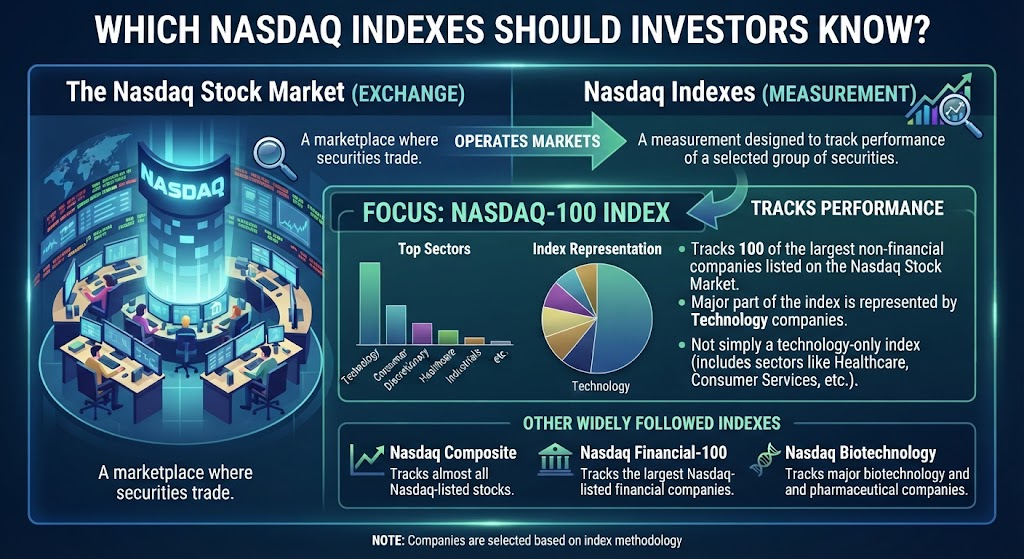
Exchange vs. Index
| Item | Purpose |
| Nasdaq Stock Market | Marketplace for securities trading |
| Nasdaq-100 | Index tracking a group of large non-financial Nasdaq-listed companies |
| NDAQ | Stock ticker for Nasdaq, Inc. |
| Individual ticker | Identifies a particular security |
This difference becomes important when reading market articles and financial headlines.
How to Research a Nasdaq Stock Step by Step
If you discover a company through fintechzoom.io nasdaq coverage, you can perform additional research before forming an opinion about the stock.
Step 1: Identify the Ticker
Start with the company’s exact ticker symbol. Similar company names can cause confusion, especially when several businesses operate in related industries.
Step 2: Check the Official Listing
Use Nasdaq’s official market resources to confirm listing and market information. Nasdaq provides information about its U.S. equities markets and listed securities.
Step 3: Read Company Filings
Search the SEC’s EDGAR database for the company’s official filings. EDGAR provides public access to millions of documents filed by public companies and other filers.
Step 4: Review Financial Results
Look at revenue, earnings, cash flow, debt, operating expenses, and management commentary when those figures are relevant to your research.
Step 5: Check the Date
A stock article from several months ago may describe a very different situation from the current market.
Step 6: Compare Multiple Sources
Use financial articles for context, but verify important claims against official company filings, Nasdaq information, and regulatory documents.
What Should You Check Before Trusting Stock Information?
Not every number shown on a financial webpage deserves the same level of confidence.
Use this checklist when researching a company:
- Publication date: Is the information current?
- Original source: Does the article identify where the number came from?
- Ticker: Is the company correctly identified?
- Financial period: Does the figure refer to the latest quarter or an older period?
- Official filing: Can you confirm it through SEC EDGAR?
- Market source: Can the trading information be checked through Nasdaq or another reliable market-data provider?
- Company statement: Did the company itself report the information?
- Opinion vs. fact: Is the article reporting a fact or offering analysis?
This approach reduces the risk of acting on outdated or misunderstood information.
FintechZoom.io Nasdaq and Technology Stocks
Nasdaq is closely associated with technology companies, although the exchange includes businesses from many industries.
FintechZoom.io specifically highlights technology stocks and Nasdaq-related trends on its homepage.
When researching a technology stock, look beyond its share-price movement. Consider the company’s revenue growth, profitability, cash position, debt, competitive position, product demand, and recent filings.
A rising stock price alone does not explain whether a company’s underlying business has improved.
How Accurate Is FintechZoom.io Nasdaq Information?
Accuracy depends on the specific information being discussed and its source.
A financial website can be useful for discovering topics, understanding market narratives, and finding explanations. But readers should verify material investment information against primary sources.
For example, the SEC’s EDGAR system provides direct access to corporate filings, while Nasdaq publishes information about its markets and services.
A practical rule is simple: use secondary analysis to understand an issue and primary documents to verify important facts.
Can FintechZoom.io Replace Official Nasdaq or SEC Data?
No. It is better to view financial media and official market sources as serving different purposes.
FintechZoom.io can help readers discover financial topics and follow market commentary. Nasdaq provides official exchange and market information, while the SEC provides access to regulatory filings through EDGAR.
For important financial decisions, checking the original source adds another layer of protection against outdated figures, misunderstood data, or reporting errors.
A Simple FintechZoom.io Nasdaq Research Table
The following workflow can help readers organize their research:
| Research question | Where to check | Why it matters |
| What stock is being discussed? | Company/Nasdaq information | Confirms identity and ticker |
| What is the latest company result? | SEC EDGAR/company IR | Uses primary financial information |
| What happened to the share price? | Nasdaq/market-data source | Checks market movement |
| Why did the stock move? | Financial news and analysis | Provides context |
| What does management say? | SEC filings/company releases | Gives first-party information |
| Is the information current? | Publication and filing dates | Prevents outdated analysis |
| Is the claim factual or opinion? | Original source | Helps separate evidence from commentary |
Common Mistakes When Searching FintechZoom.io Nasdaq
Several simple mistakes can create confusion.
Mistake 1: Treating the Phrase as a Ticker
FintechZoom.io Nasdaq is not an individual stock symbol.
Mistake 2: Confusing Nasdaq With Nasdaq, Inc.
Nasdaq can refer to the stock exchange and market ecosystem, while Nasdaq, Inc. is a publicly traded company whose ticker is NDAQ.
Mistake 3: Using Old Prices
Stock prices change continuously during market sessions. Always check the date and time associated with price information.
Mistake 4: Ignoring Primary Sources
An article can summarize a company’s results, but the company’s filing provides the underlying disclosure.
Mistake 5: Treating Analysis as Fact
Words such as “could,” “may,” or “expected” can indicate analysis rather than confirmed information. Read the original source before treating such statements as facts.
Frequently Asked Questions
What does fintechzoom.io nasdaq mean?
Fintechzoom.io nasdaq refers to Nasdaq-related market coverage found on FintechZoom.io. It is not the name of a stock or Nasdaq ticker.
Is FintechZoom.io the official Nasdaq website?
No. FintechZoom.io is a financial information website. Nasdaq operates its own official market and corporate websites.
Is fintechzoom.io nasdaq a stock?
No. It is a search phrase connecting FintechZoom.io with Nasdaq-related information. Nasdaq, Inc., however, is publicly traded under the ticker NDAQ.
Where can I verify Nasdaq company information?
Use Nasdaq’s official resources and the SEC’s EDGAR database. EDGAR allows investors to search public filings by company name, ticker symbol, or CIK.
Does FintechZoom.io cover technology stocks?
Yes. FintechZoom.io says its Nasdaq coverage includes technology-stock trends, company earnings, and industry analysis.
Should I rely on one website before investing?
No. Compare financial commentary with primary information such as company filings, official investor-relations releases, and market data. This gives you more context and helps you identify outdated or incomplete information.
Conclusion:
FintechZoom.io Nasdaq is best understood as a search phrase for Nasdaq-related financial coverage on FintechZoom.io, not as a stock or ticker. FintechZoom.io can help readers discover market topics and analysis, while Nasdaq and the SEC provide important primary information for verification.
If you are researching a Nasdaq-listed company, start with the ticker, check current market information, review the company’s latest filings, and then use financial analysis to understand the broader story. That simple process creates a clearer and more reliable research path than relying on a single webpage.